

Market Reaction to Recent Macro Risks has been Surprisingly Sanguine
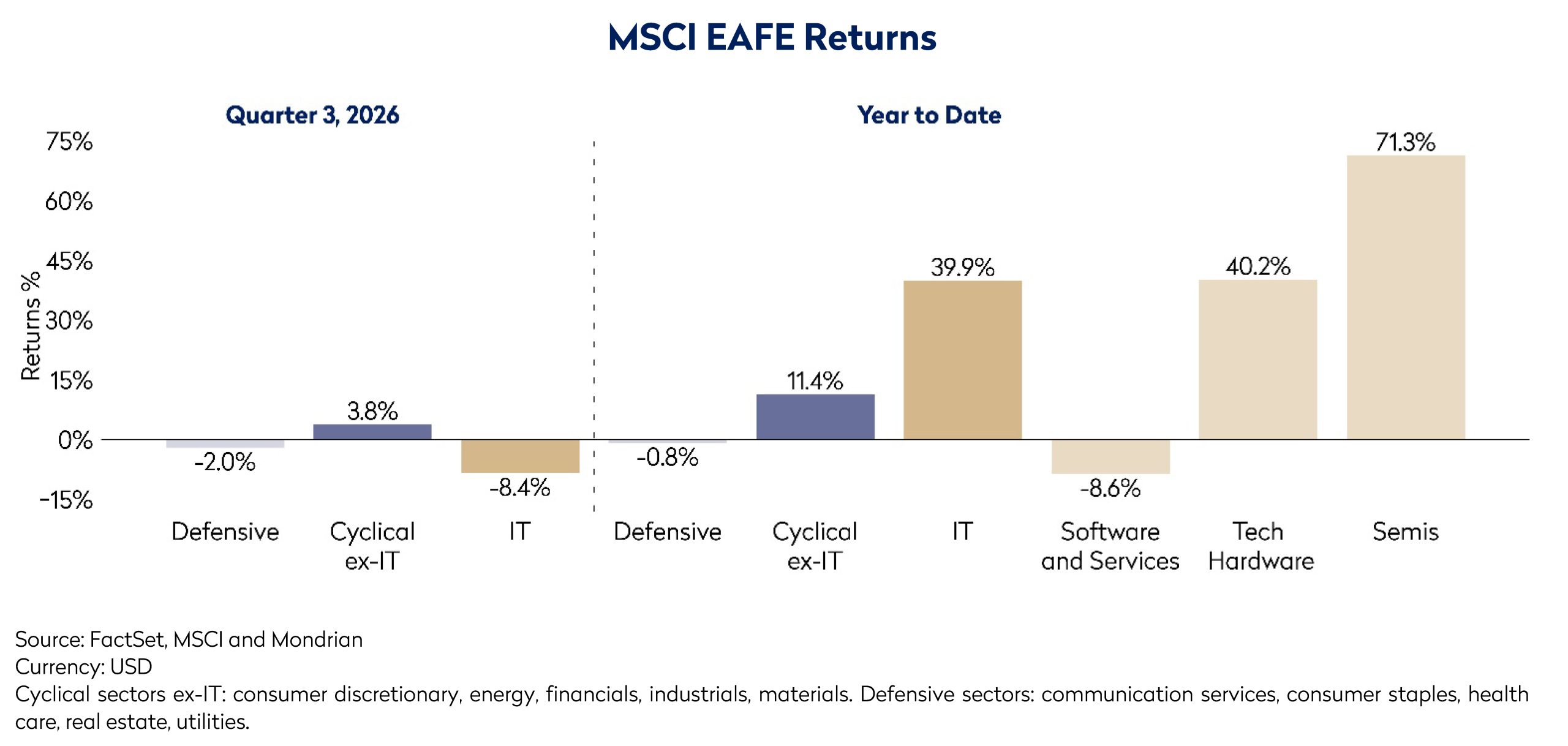
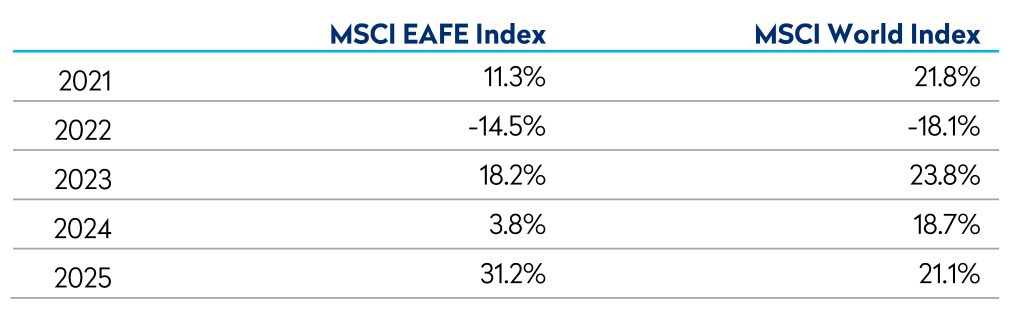
Developed market equities have delivered solid returns over the past five years – approximately 11.9% p.a. globally and 9.3% p.a. outside the US. This strength has continued into 2026: so far this year, MSCI World has gained 11.8%, while MSCI EAFE is up 10.3% in USD terms, with both indices only 2.4% and 3.9% below their respective all-time highs set during the third quarter. Investor enthusiasm for stocks associated with AI has outweighed concerns that might previously have derailed a similar rally, including conflict in the Middle East, surging energy prices, firmer inflation and higher bond yields. While the AI trade partially reversed in Q3, the Information Technology sector is still the strongest-performing sector year to date, with index gains concentrated in a narrow group of cyclical and technology stocks.
Beneath the market’s calm exterior, we believe that the uncertainties are large and that the range of outcomes between our scenarios is widening. Near-term earnings growth is expected to remain strong – but the bar is now very high, making outsized advances increasingly difficult. While the long-term outlook for AI remains compelling, the pace of data center build-out is vulnerable to fickle financial market funding at a time of rising bond yields and an increasingly pressured supply chain.
Oil Topped USD 100 Once Again in Q3 as the Iran Conflict Dragged On
Earlier this year, in an Outlook that examined both the shorter- and longer-term implications of the Iran conflict, we wrote about the threat to the global economy posed by rising oil price benchmarks, underlining that a short war was imperative from a global energy and supply perspective. It is now seven months since the start of the Iran conflict, and the Brent futures price has averaged ~USD 94/bbl since March – roughly 60% above where it began the year. Oil prices have surged since the start of 2026, spiking to USD 113/bbl in early September after attacks on Saudi infrastructure. But why is the oil price not even higher, given the extended period of supply disruption?
First, the supply disruption caused by the closure of the Strait of Hormuz has been somewhat less impactful than our base case assumption of 12-14 mbd. Oil volumes out of the Persian Gulf since the start of the crisis have ranged from 4-18mbd and averaged ~9-10mbd, implying average stranded supply of “only” 10-11mbd.
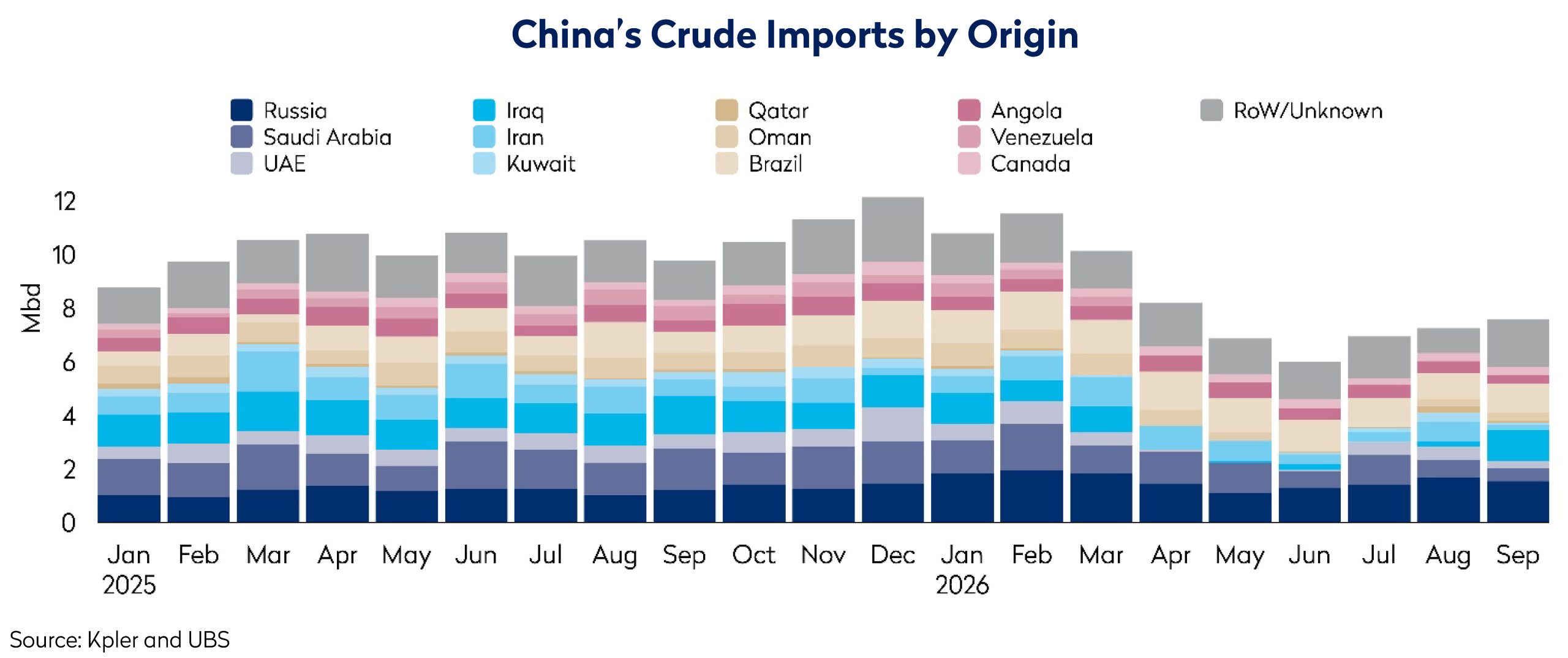
Second, and more importantly, demand destruction and inventory drawdowns were more pronounced than expected. There was a sharp ~4mbd drop in Chinese oil imports (see the chart below), as industrial activity was throttled back and strategic reserves were drawn down (reserves which had been assiduously built up over the last few years). For calendar year 2026, the IEA now forecasts a global oil demand decline of 2.5mbd. Concurrently, and in line with expectations, we saw strategic reserve releases from IEA member countries, in particular the US, Europe and Japan, to help manage the supply shock.
Nevertheless, the longer the conflict continues, the more these cushioning effects are likely to fade. Chinese demand will return, inventories are finite, and the prospect of additional stranded volumes is now in play: at the time of writing the conflict has recently expanded, with drone attacks on Saudi Arabia’s East-West pipeline causing the temporary closure of this artery, and with Iran-aligned Yemeni Houthi forces now advancing down the Red Sea coast, threatening Saudi oil exports via the Bab el-Mandeb strait. Potentially, 17-18mbd of oil could be stranded if both the Strait of Hormuz and the Bab el-Mandeb strait are firmly blocked.
Whilst the oil price has been tethered closer to USD 100/bbl than we would have expected back in March, only now are the tail risks of a higher oil price emerging as the various cushioning effects outlined above diminish. This prospect, along with rising inflation, higher 10-year US Treasury yields, and looming mid-term elections are heaping pressure on the Trump administration to de-escalate. Yet the key issues we identified in March remain unresolved – namely, control over Iran’s nuclear program, and control of the Strait of Hormuz. Any near-term de-escalation is unlikely to adequately address these sources of friction, implying an extended period of volatility for the region, and for oil markets.
Surging Energy Prices have Tightened Financial Conditions
The 10-Year US Treasury yield crossed the 5.0% landmark during the quarter – touching a new 19-year high as it reached 5.2% in late September, having stood just below 4.0% before the war began – as oil prices rose and the Federal Reserve raised rates. The US central bank’s quarter-point rate hike in September, its first increase since 2023, was approved unanimously, with a clear majority of policymakers signaling at least one more increase this year. While the US bond sell-off has captured the majority of attention, sovereign bond concerns have broadened globally. The ECB and Bank of Japan have also tightened in 2026. The Middle East crisis, inflation, fiscal strains in highly indebted countries and competing demands from the financing needs of US mega-caps have pushed global yields to levels not seen since before the Global Financial Crisis.
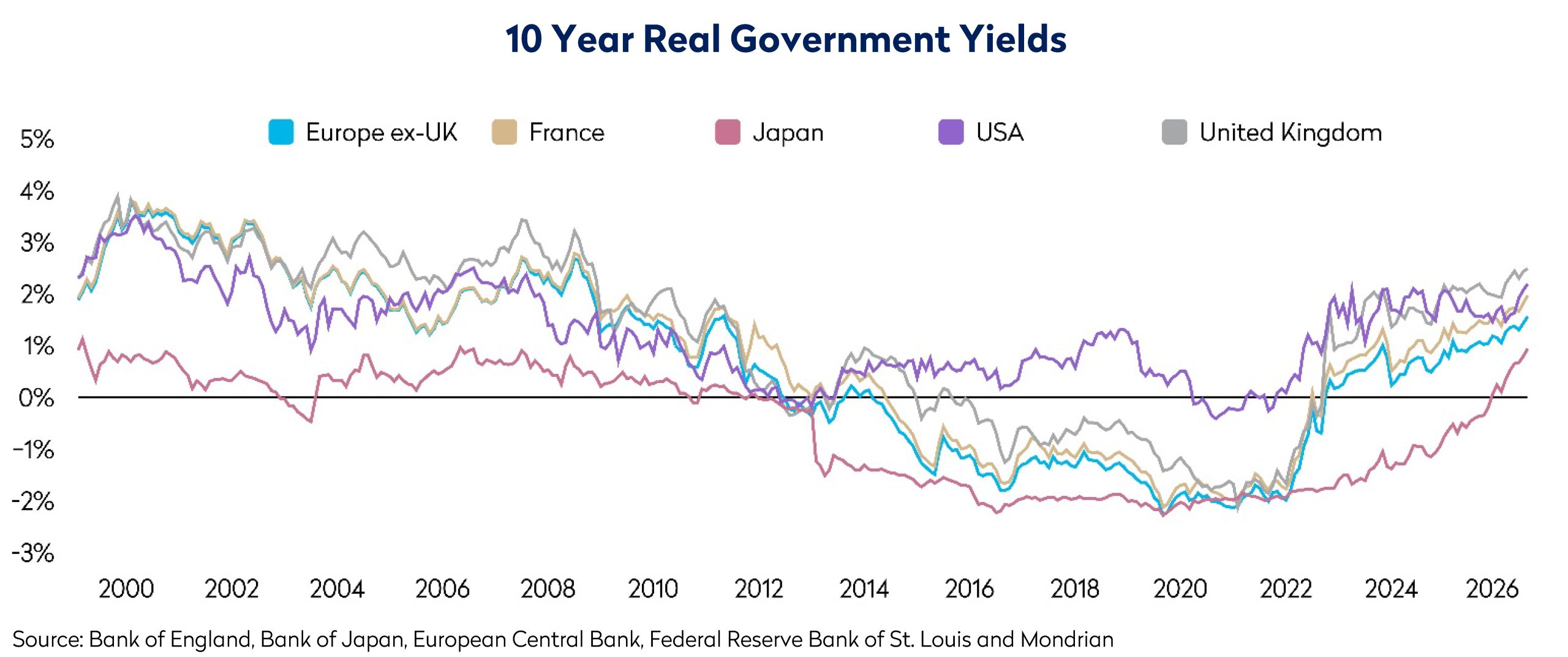
The US looks particularly exposed if bond market concerns spill over into equity markets. Many US stocks, as well as a number of AI-related names outside of the US, currently trade at demanding valuations that require unprecedented future cashflow generation, making their valuations very sensitive to a rising cost of capital. Further, higher yields raise the cost of capital and therefore the returns growth projects must generate to create value – a particular concern for US companies participating in the AI build-out. Annual investment by the five largest hyperscalers is now running at USD 750-800bn, with a growing share of AI infrastructure being financed through debt and other external capital, even as investors have begun to question the returns on this spending.
While we recognize the potentially transformative impact of AI, we remain mindful of the distinction between identifying long-term structural growth and the price investors are being asked to pay for it today. Rather than relying on any single point estimate, we use scenario analysis to assess how different outcomes for energy prices, inflation and AI investment could affect the earnings and cash flows of the individual companies we assess. That discipline keeps our portfolios tilted towards securities where the long-term cash-flow potential of the business offers compelling value across the range of outcomes, not only the most favorable.
Narrow Markets have Created Stock-Picking Opportunities
At the same time, we believe the extreme narrowness of the recent market rally has created an increasingly attractive environment for fundamental stock picking. Companies outside the immediate focus of the AI-driven rally have received considerably less investor attention. Within this group there are many high-quality companies, possessing resilient business models, attractive competitive positions and the ability to generate substantial long-term cash flows. This divergence has expanded the opportunity set for bottom-up investors: rather than attempting to predict which investment theme might lead markets in the short term, we look for businesses where the price we pay is attractive relative to the cash flows we believe those companies can generate over time. We have initiated new positions across a few different sectors, notably in Nintendo and BNP Paribas.
Nintendo, the Japanese video game company, operates the highly successful Switch platform. The business is diversified by geography – Japan is only its third-largest market, behind the US (40% of revenues) and Europe (approx. 25.0%). The console market is an attractive three-player oligopoly controlled by Nintendo (Switch), Sony (PlayStation) and Microsoft (Xbox). Nevertheless, the company’s shares fell by roughly a third in the first half of the year due to concerns on elevated memory costs and a relatively light near-term software release slate. We see these as short-term headwinds that create an attractive entry point for long-term investors. The investment case is further supported by an exceptionally strong balance sheet, with cash and marketable securities accounting for more than one-third of the company’s market capitalization.
Despite our view that the company is undervalued, we remain mindful of the associated risks. Most obviously, generative AI tools are lowering the video game industry’s barriers to entry, in particular the cost of producing games. However, we believe this dynamic will aid those game developers with the strongest first-party intellectual property the most. In addition, the company’s control of its hardware ecosystem should further insulate it from competitive pressures. In our view, Nintendo is a high-quality asset currently offering an attractive base case valuation and a compelling range of outcomes.
France-listed BNP Paribas is the leading corporate bank in the eurozone. Hence, it is well-placed to capitalize on any prospective increase in investment levels in the region, potentially associated with rearmament, energy security or an intention to tackle weak economic competitiveness. Its two most important retail franchises are in France and Belgium, where they are only now benefitting from higher interest rates due to the long duration of their lending. Lastly, they have several so-called “platform businesses” which should grow reliably over the long-term, supported by their association with the wider group. For example, they have large insurance and asset management operations, and a large auto leasing business. We project strong growth in shareholder distributions. The starting P/E multiple is c.8x and the dividend yield is c.6.0%.
The number and range of new stocks that have been added to portfolios in the last year, despite strong equity market returns, reflect the narrowness of the rally. We think the opportunity set for long-term, value-oriented investors has remained quite rich, as evidenced by recent portfolio changes.
Conclusion
Markets have recovered very quickly from a number of shocks in recent years, including conflicts and escalating geopolitical tensions, tariff-related turbulence, cost of living crises, and recent unease in private credit markets. The absence of any major economic slowdown alongside a sustained equity bull market has meant the downside protection we typically provide has appeared less relevant in recent times. Nonetheless, it seems clear that risks in the system continue to build: government debt and deficits are hard political problems, bond yields are rising, oil prices are elevated and volatile, and the geopolitical environment is clearly fractious.
Despite strong equity markets, the narrowness of the rally and investors’ focus on a small group of perceived AI “winners” and “losers” have created opportunities in less high-profile markets and sectors. We continue to test our assumptions rigorously across multiple scenarios while preserving the portfolio’s core characteristics.
We believe the current environment is particularly conducive to identifying undervalued securities that are being overlooked or indiscriminately marked down by a market focused on the short term. In our view, the portfolio is well positioned across a wider range of outcomes, with the balance of risks and opportunities becoming increasingly attractive.
Disclosures
Views expressed were current as of the date indicated, are subject to change, and may not reflect current views. All information is subject to change without notice. Views should not be considered a recommendation to buy, hold or sell any investment and should not be relied on as research or advice.
This document may include forward-looking statements. All statements other than statements of historical facts are forward-looking statements (including words such as “believe,” “estimate,” “anticipate,” “may,” “will,” “should,” “expect”). Although we believe that the expectations reflected in such forward-looking statements are reasonable, we can give no assurance that such expectations will prove to be correct. Various factors could cause actual results to differ materially from those reflected in such forward-looking statements.
Neither MSCI nor any other party involved in or related to compiling, computing or creating the MSCI data makes any express or implied warranties or representations with respect to such data (or the results to be obtained by the use thereof), and all such parties hereby expressly disclaim all warranties of originality, accuracy, completeness, merchantability or fitness for a particular purpose with respect to any of such data. Without limiting any of the foregoing, in no event shall MSCI, any of its affiliates or any third party involved in or related to compiling, computing, or creating the data have any liability for any direct, indirect, special, punitive, consequential or any other damages (including lost profits) even if notified of the possibility of such damages. No further distribution or dissemination of the MSCI data is permitted without MSCI’s express written consent.
This material is for informational purposes only and is not an offer or solicitation with respect to any securities. Any offer of securities can only be made by written offering materials. The information set forth herein is a summary only and does not set forth all of the risks associated with the investment strategy described herein.
The information was obtained from sources we believe to be reliable, but its accuracy is not guaranteed, and it may be incomplete or condensed.
It should not be assumed that investments made in the future will be profitable or will equal the performance of any security referenced in this document. Examples of securities will represent only a small part of the overall portfolio and are used to illustrate our investment approach. Any holdings are subject to change and may not feature in any future portfolio. More information on holdings is available on request.
Unless otherwise stated, all returns are in USD.
All references to index returns assume the reinvestment of dividends after the deduction of withholding tax and approximate the minimum possible re-investment, unless the index is specifically described as a “Gross” index
Past performance is not a guarantee of future results. An investment involves the risk of loss. The investment return and value of investments will fluctuate.
Mondrian Investment Partners Limited is authorized and regulated by the Financial Conduct Authority (Firm Reference Number: 149507). Mondrian Investment Partners Limited is also registered as an Investment Adviser with the Securities and Exchange Commission (registration does not imply any level of skills or training).
This marketing communication is for Professional Investors only.