

Governance Reform and Shareholder Returns in Emerging Markets
Emerging Market (EM) equities have traded at a discount to developed markets for much of the past two decades. Political risk, economic volatility, slower growth in some countries and a different sector mix explain part of that gap. Corporate governance explains another part. A company can report attractive earnings, own valuable assets and hold surplus cash, yet still prove a poor investment if minority shareholders have little influence over how those resources are used.
For value investors, this distinction is fundamental. A low PE ratio indicates that a company is cheap relative to reported profits. It does not indicate whether those profits will be distributed, reinvested at an adequate return or consumed by acquisitions, related party transactions and excess capital expenditure. In many emerging markets, investors have historically applied a high discount rate because the route from corporate earnings to shareholder returns was uncertain.
That route has arguably been improving. Regulators in China and South Korea, two of EM’s largest markets, are placing greater pressure on companies to pay dividends, cancel repurchased shares and treat minority investors more fairly. Companies are responding with clearer payout policies and, in several cases, larger returns of capital. This does not remove the need for careful valuation, but it increases the chance that value embedded in a balance sheet becomes a realized return rather than remaining trapped indefinitely. In Korea especially, current large cash windfalls for the memory companies should make possible highly material returns to shareholders, which may recalibrate what investors consider an appropriate valuation level if policies are believed to have improved for the long term.
Why Cheap Companies Can Stay Cheap
Governance is usually treated as a qualitative issue separate from valuation. In practice, it enters directly into any estimate of intrinsic value. Equity value is ultimately determined by the cash that can be distributed to its owners over time. Reported earnings provide the capacity for those distributions, but capacity and willingness are not the same thing.
A controlling shareholder may prefer to retain cash because it increases the scale of the company and preserves control. Management may pursue acquisitions or new capacity even when prospective returns are below the cost of capital. Conglomerates can use profitable subsidiaries to support weaker affiliates, while treasury shares may be retained and subsequently reissued rather than cancelled. Each practice can reduce the economic value of reported profits to outside shareholders.
Dividends, the foundation of Mondrian’s valuation process, help close this gap by transferring cash beyond management control. Buybacks can do the same when shares are purchased below intrinsic value and cancelled. Higher distributions do not automatically create value – companies capable of reinvesting at high returns should retain an appropriate share of profits. The important question is whether management can earn more on retained capital than shareholders could reasonably expect elsewhere. A credible payout policy imposes discipline on that decision and reduces the amount of faith investors must place in management’s future choices.
China Shifts Towards Shareholder Distributions
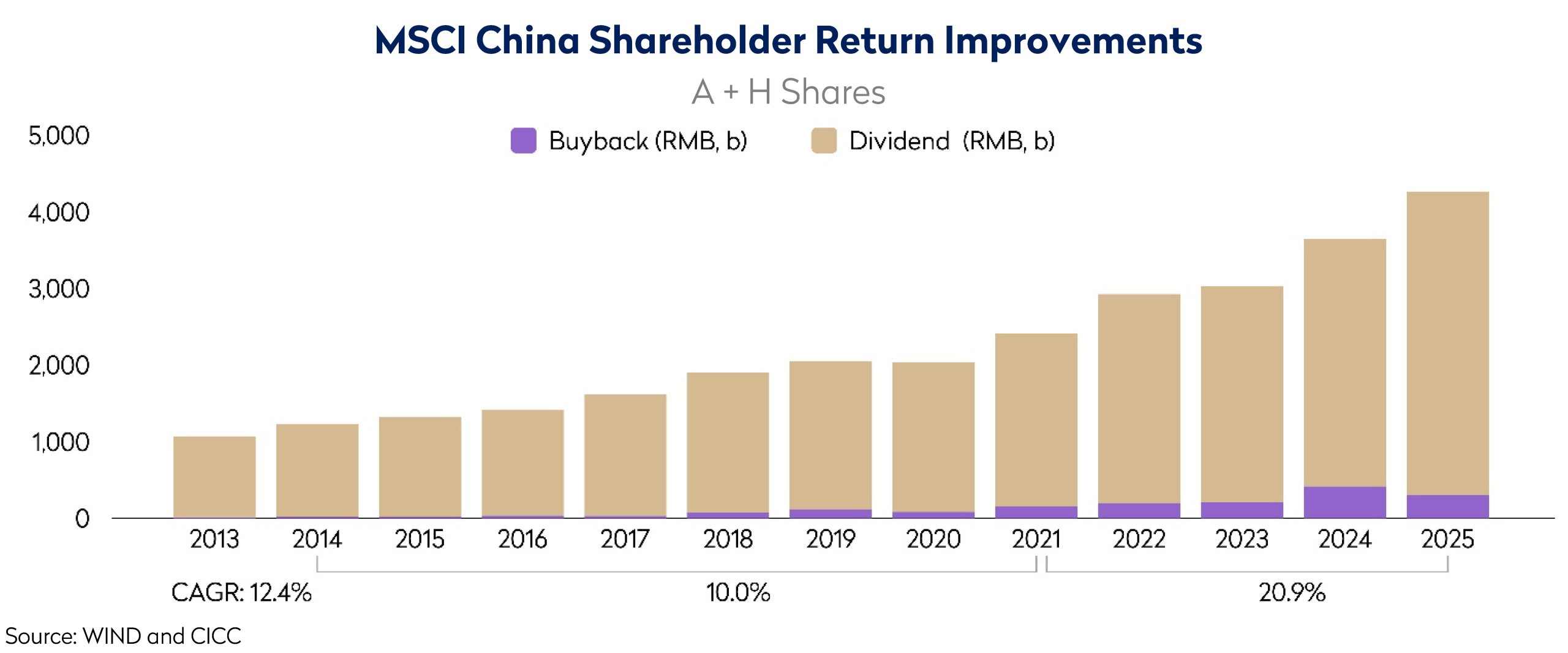
China’s equity market was historically built primarily to finance companies and national development, with the interests of secondary market investors often less prominent. Consequently, strong economic and corporate profit growth did not always translate into attractive shareholder returns. More recently, in a lower growth environment, authorities have placed greater emphasis on investor protection, cash dividends, buybacks and the quality of listed companies.
The change is becoming visible in cash payments. A-share companies paid a record RMB 2.6 trillion of dividends in 2025¹. The largest payments continue to come from state-owned banks, telecom operators and energy companies, but private companies have also increased distributions materially.
This matters because many Chinese companies have strong balance sheets and trade on modest valuations. A regular dividend can provide a meaningful portion of an investor’s required return while waiting for an improvement in earnings or sentiment. The caveats remain: a high payout from a company with structurally declining profits may prove unsustainable, while state-owned enterprises must balance shareholder returns against policy objectives. Nevertheless, the direction of policy is significant. Chinese authorities increasingly appear to regard durable shareholder returns as important to the development of the domestic equity market.
There are also offsetting forces. China’s large technology companies, including Alibaba and Tencent, are sharply increasing investment in AI infrastructure, putting near term pressure on free cash flow. After several years in which improving cash generation supported rising dividends and buybacks, this investment cycle may temporarily reverse that trend. Stronger governance improves the willingness to return excess cash but cannot guarantee that excess cash will always be available. This is a trend we are monitoring very closely.
Korea Makes Buybacks More Meaningful
South Korea provides perhaps the clearest recent example of governance reform becoming an equity market catalyst. The longstanding Korea discount reflected complex conglomerate structures, low payout ratios, cross shareholdings and concern that boards served controlling Chaebol families more reliably than outside shareholders. Treasury shares were a particular concern because companies could repurchase stock without cancelling it and subsequently use those shares in ways that reinforced existing control.
Recent Commercial Act reforms have changed the economics of that practice. Alongside measures encouraging improved dividend payments and extending directors’ duties towards shareholders, listed companies are now generally required to cancel newly acquired treasury shares within one year.
The reforms will not eliminate the Korea discount. Controlling shareholders remain influential, corporate structures remain complicated, and capital allocation will continue to vary. They do, however, increase the probability that excess cash is either invested productively or returned in a form that benefits all shareholders. That can justify a lower governance discount even before the underlying rate of earnings growth changes.
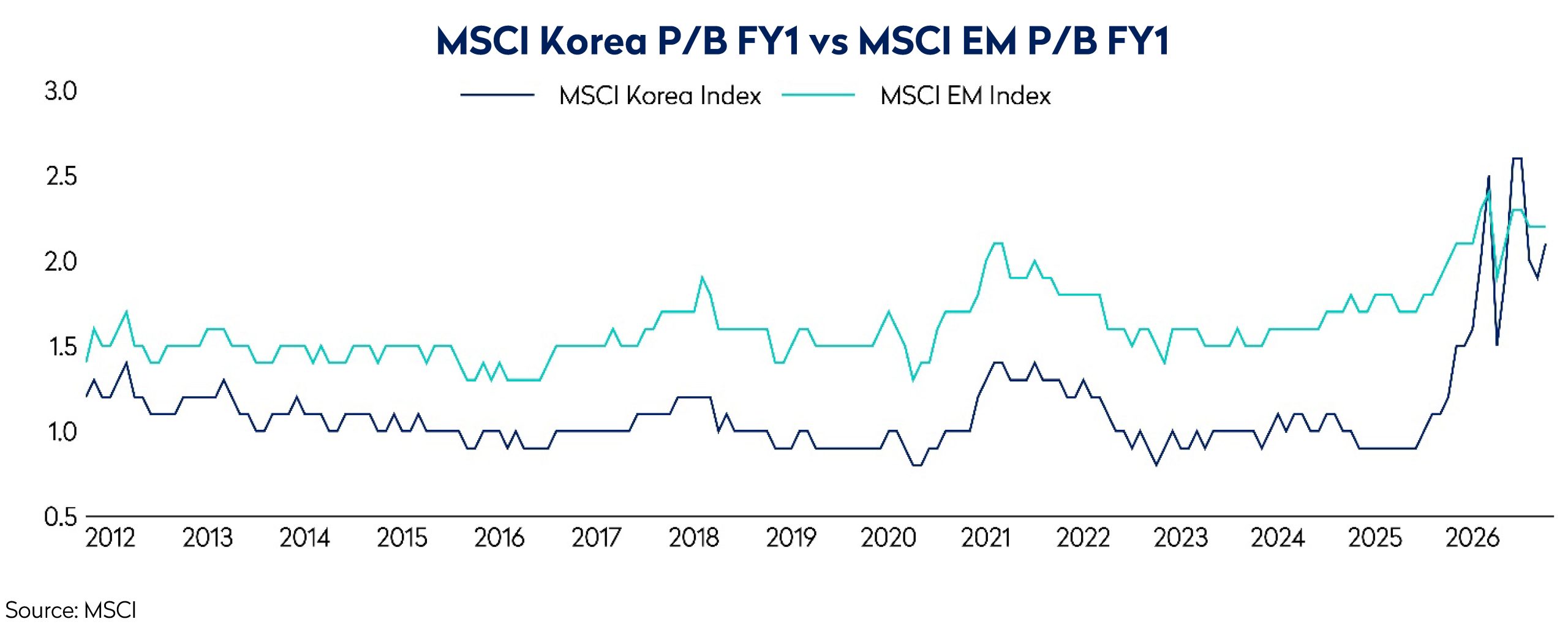
In the chart below, you can see how the Price to Book discount of Korea versus MSCI EM has narrowed over the last twelve months, helped by improving governance as well as memory company valuations.
Samsung Electronics and SK Hynix
Samsung Electronics and SK Hynix illustrate both the opportunity created by stronger shareholder return policies and the judgement still required. Exceptionally strong memory pricing and demand for high bandwidth memory are generating substantial cash flows, although both companies are also investing heavily. Free cash flow, rather than headline earnings, therefore, remains the best measure of what can ultimately be returned.
Samsung’s current policy commits 50% of cumulative free cash flow over three years to shareholder returns, including its regular dividend. Strong cash generation has enabled distributions to rise significantly through dividends and buybacks, although there may be scope to distribute considerably more of the current windfall.
SK Hynix has gone further, recently committing to return more than half of cumulative three year free cash flow under its 2025–27 policy, and announcing a substantial buyback with the shares acquired to be cancelled. Strong cash generation and net cash balance sheets create scope for larger distributions should the memory environment remain favorable.
Some broker estimates suggest² both companies could potentially return sums equivalent to approximately half their current market capitalizations over the next three years if memory prices remain robust. Such estimates illustrate the extraordinary scale of current cash generation but should not be capitalized as though peak memory profits will persist indefinitely. Memory earnings remain cyclical; investment requirements are substantial and neither company’s current policy provides indefinite visibility.
The more important development is therefore structural. Shareholders now have a clearer claim on excess cash flow, while cancelled buybacks ensure that some of the benefit survives even if industry profitability subsequently normalizes. Given the size of Samsung and SK Hynix within the EM universe, how these policies develop could materially influence perceptions of the broader Korea discount.
Shareholder Returns Still Require Judgement
None of the above removes the need for careful analysis. Semiconductor profits are unusually high, and supply will eventually respond. Across emerging markets more broadly, dividends can be cut, buybacks can be poorly timed, and governments can alter the priorities of state controlled companies. Governance reform should improve outcomes; it does not remove business or valuation risk.
For a value investor, an attractive combination is a strong balance sheet, cash generation that remains positive under conservative assumptions and a payout policy that leaves sufficient resources for productive investment. Scenario analysis remains essential. A high headline yield based on peak profits offers little protection if free cash flow disappears in the downside case. Conversely, a company priced near a conservative estimate of value can become particularly attractive when credible distributions reduce the time required to realize that value.
This is why the changes in China, and particularly Korea, deserve attention beyond the immediate size of announced payments. EM discounts have often reflected a rational concern that minority shareholders would receive too little of the value their companies created. Stronger legal protections, mandatory treasury share cancellation and more explicit payout policies begin to address that concern. Given the significant size of the Korean memory companies in the EM Index, a successfully implemented and well received shareholder return policy could be profoundly influential in how investors perceive the overall discount for EM going forwards.
Disclosures
¹ Source: WIND and CICC
² Jeffries, KB Securities
Views expressed were current as of the date indicated, are subject to change, and may not reflect current views. All information is subject to change without notice. Views should not be considered a recommendation to buy, hold or sell any investment and should not be relied on as research or advice.
This document may include forward-looking statements. All statements other than statements of historical facts are forward-looking statements (including words such as “believe,” “estimate,” “anticipate,” “may,” “will,” “should,” “expect”). Although we believe that the expectations reflected in such forward-looking statements are reasonable, we can give no assurance that such expectations will prove to be correct. Various factors could cause actual results to differ materially from those reflected in such forward-looking statements.
Neither MSCI nor any other party involved in or related to compiling, computing or creating the MSCI data makes any express or implied warranties or representations with respect to such data (or the results to be obtained by the use thereof), and all such parties hereby expressly disclaim all warranties of originality, accuracy, completeness, merchantability or fitness for a particular purpose with respect to any of such data. Without limiting any of the foregoing, in no event shall MSCI, any of its affiliates or any third party involved in or related to compiling, computing, or creating the data have any liability for any direct, indirect, special, punitive, consequential or any other damages (including lost profits) even if notified of the possibility of such damages. No further distribution or dissemination of the MSCI data is permitted without MSCI’s express written consent.
This material is for informational purposes only and is not an offer or solicitation with respect to any securities. Any offer of securities can only be made by written offering materials. The information set forth herein is a summary only and does not set forth all of the risks associated with the investment strategy described herein.
The information was obtained from sources we believe to be reliable, but its accuracy is not guaranteed, and it may be incomplete or condensed.
It should not be assumed that investments made in the future will be profitable or will equal the performance of any security referenced in this document. Examples of securities will represent only a small part of the overall portfolio and are used to illustrate our investment approach. Any holdings are subject to change and may not feature in any future portfolio. More information on holdings is available on request.
Unless otherwise stated, all returns are in USD.
All references to index returns assume the reinvestment of dividends after the deduction of withholding tax and approximate the minimum possible re-investment, unless the index is specifically described as a “Gross” index
Past performance is not a guarantee of future results. An investment involves the risk of loss. The investment return and value of investments will fluctuate.
Mondrian Investment Partners Limited is authorized and regulated by the Financial Conduct Authority (Firm Reference Number: 149507). Mondrian Investment Partners Limited is also registered as an Investment Adviser with the Securities and Exchange Commission (registration does not imply any level of skills or training).
This marketing communication is for Professional Investors only.